Pearson Edexcel · GCSE · Business
Course version: 1BS0 · Version from Sept 2017
Why business aims and objectives change as businesses evolve: ● in…
Full specification wording
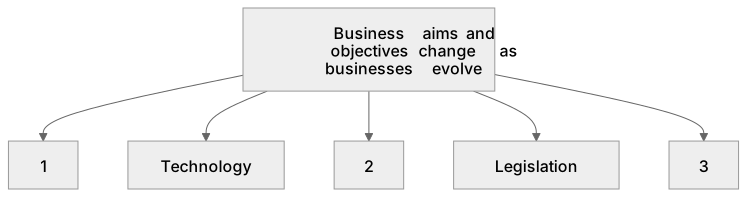
Changes in business aims and objectives: Why business aims and objectives change as businesses evolve: ● in response to: market conditions, technology, performance, legislation, internal reasons.
As businesses evolve, their aims and objectives must adapt to internal and external pressures.
Checked against the Pearson Edexcel 1BS0 specification (opens in a new tab) on .
- Point 1 of 2
Study notes
From the checked teaching notes for this specification point.
The idea
As businesses evolve, their aims and objectives must adapt to internal and external pressures. External market conditions, such as a recession or new competitors, might force a shift from profit maximisation to survival. Rapid changes in technology require businesses to update objectives, perhaps aiming to increase e-commerce sales. Poor financial performance often triggers a change in direction to cut costs or improve cash flow. Furthermore, new legislation, like stricter environmental laws or minimum wage increases, can force a business to alter its ethical or financial targets to ensure compliance. Finally, internal reasons, such as a change in leadership or a desire to improve corporate culture, can redefine a company's strategic focus.
What earns the marks
- Explain how changing market conditions, such as economic downturns, shift objectives from growth to survival.
- Analyse the impact of new technology on business aims, such as investing in automation to improve efficiency.
- Evaluate how poor financial performance forces a business to adopt cost-minimisation or retrenchment objectives.
- Assess the role of new legislation, such as environmental regulations, in forcing businesses to adopt compliance or sustainability targets.
- Identify internal reasons for changing objectives, such as a new chief executive implementing a different strategic vision.
Common mistakes and how to put them right
Confusing internal reasons with external market conditions.
Put it right: Clearly distinguish between internal factors like a change in management and external factors like competitor actions.
Assuming aims only change when a business is failing.
Put it right: Recognise that successful performance can also cause aims to change, such as shifting from survival to rapid expansion.
Stating that legislation only affects costs.
Put it right: Explain that legislation can fundamentally change strategic objectives, such as forcing a shift towards environmentally sustainable practices.
Exam tips
- Use the context provided in the case study to identify exactly which factor, such as technology or legislation, is driving the change in objectives.
- When evaluating the impact of changing aims, always link the change back to the specific trigger, such as poor financial performance.
- Remember that a change in objectives often requires a reallocation of resources, which can be used as an analytical point in longer answers.
Try the lesson
The start of the Changes in business aims and objectives: Why business aims and objectives change as businesses evolve: ● in response to: market conditions, technology, performance, legislation, internal reasons. lesson, made from checked teaching notes for this specification point.
Have a go first
A bakery decides to change its objective from increasing profit to reducing waste after a new law is passed regarding food disposal. Which factor has caused this change in objective?
Listen
As businesses evolve, their aims and objectives must adapt to internal and external pressures. External market conditions, such as a recession or new competitors, might force a shift from profit maximisation to survival. Rapid changes in technology require businesses to update objectives, perhaps aiming to increase e-commerce sales. Poor financial performance often triggers a change in direction to cut costs or improve cash flow. Furthermore, new legislation, like stricter environmental laws or minimum wage increases, can force a business to alter its ethical or financial targets to ensure compliance. Finally, internal reasons, such as a change in leadership or a desire to improve corporate culture, can redefine a company's strategic focus. A strong answer earns marks for these points. Explain how changing market conditions, such as economic downturns, shift objectives from growth to survival. Analyse the impact of new technology on business aims, such as investing in automation to improve efficiency. Evaluate how poor financial performance forces a business to adopt cost-minimisation or retrenchment objectives. Assess the role of new legislation, such as environmental regulations, in forcing businesses to adopt compliance or sustainability targets. A common slip: Confusing internal reasons with external market conditions. Instead, Clearly distinguish between internal factors like a change in management and external factors like competitor actions. Exam tip: Use the context provided in the case study to identify exactly which factor, such as technology or legislation, is driving the change in objectives.
See it

Label the diagram
Some boxes have lost their names. Pick the right name for each number.
1Box 1
2Box 2
3Box 3
There is more to this lesson
The full lesson goes on to check your understanding and help you earn the marks. Create a free account to carry on, with your progress saved.
A week of Premium from your first lesson · Then the free plan continues · No card, no charge
Test your understanding of Changes in business aims and objectives: Why business aims and objectives change as businesses evolve: ● in response to: market conditions, technology, performance, legislation, internal reasons.
Active recall beats re-reading. Take an instant quiz now to test what you’ve learned and lock it into long-term memory.
A week of Premium from your first lesson · Then the free plan continues · No card, no charge